At some point in most briefing calls this year, someone says the sentence. "Can't we just do it in AI? It'll be cheaper." Sometimes it's the founder, sometimes the agency, sometimes a cousin who has seen a very convincing video of a cat flying a plane. It's a fair question, and it deserves a better answer than a sales pitch or a sulk.
We shoot beauty, skincare and product films in Mumbai every week, and AI video production and hybrid AI and live action work sit on our services list too, so we have no reason to be precious in either direction. Here is what AI video can genuinely do for a brand right now, what it still can't, what actually drives the cost, and what India's advertising rules now expect you to tell your audience. Accurate as of September 2026, which in AI terms is roughly a geological era.
What AI video is genuinely good at
Start with the good news, because there is plenty of it. In the hands of someone with taste, generative video is already useful in six places.
- Concepting and mood. Treatment frames, colour worlds, a look for the bathroom set before anyone books a recce. A client can react to a picture instead of a paragraph, which saves a whole round of "that's not quite what we meant".
- AI storyboards and animatics. A moving storyboard shows the rhythm of the edit before a shoot day is booked. Approving a film as moving pictures, not a PDF of sketches, takes a lot of surprises off the set.
- Backgrounds and environments. Skies, landscapes, abstract spaces, set extensions, the view out of a window that doesn't exist. Nobody checks a sky for accuracy.
- Variations and localisation. Once a shot is approved, AI is good at making more of it: a monsoon version and a Diwali version, a different backdrop per market, a reframe for every placement.
- Some product visualisation. A product that isn't manufactured yet, a cutaway, an ingredient world where a rose petal turns into a drop of serum. These are fantasies anyway, and everyone watching knows it.
- Volume for social. Ten rough hooks to test instead of two. Ideas get to die cheaply, which is the best thing that can happen to most ideas.
The industry has noticed. The US Interactive Advertising Bureau's July 2025 video ad spend report found that 86 percent of the ad buyers it surveyed were using or planning to use generative AI to build video ad creative. The uses it named first were versions for different audiences (42 percent) and changes of visual style (38 percent). Look at that list. AI is at its strongest making more of something that already works, and helping everyone agree on what to make in the first place.
Where it still struggles for beauty and product brands
Now the less shareable part. The places where AI video still stumbles happen to be exactly where beauty and product brands live.
Skin that behaves like skin
Skin is semi translucent. Light goes into it, scatters, and comes back out softer, which is what makes a face look alive on camera and a big part of why skincare is the hardest genre we film. Generated faces tend to fall off one side or the other: poreless wax, or texture that shimmers and crawls from frame to frame. Beauty audiences look at skin for a living. They notice.
It's the same reason we don't replace skin in post on a real shoot. Our line on real versus retouched skin is that texture stays, because texture is where a skincare product proves itself. A face with no texture has nothing left for the product to improve.
A product that changes its mind
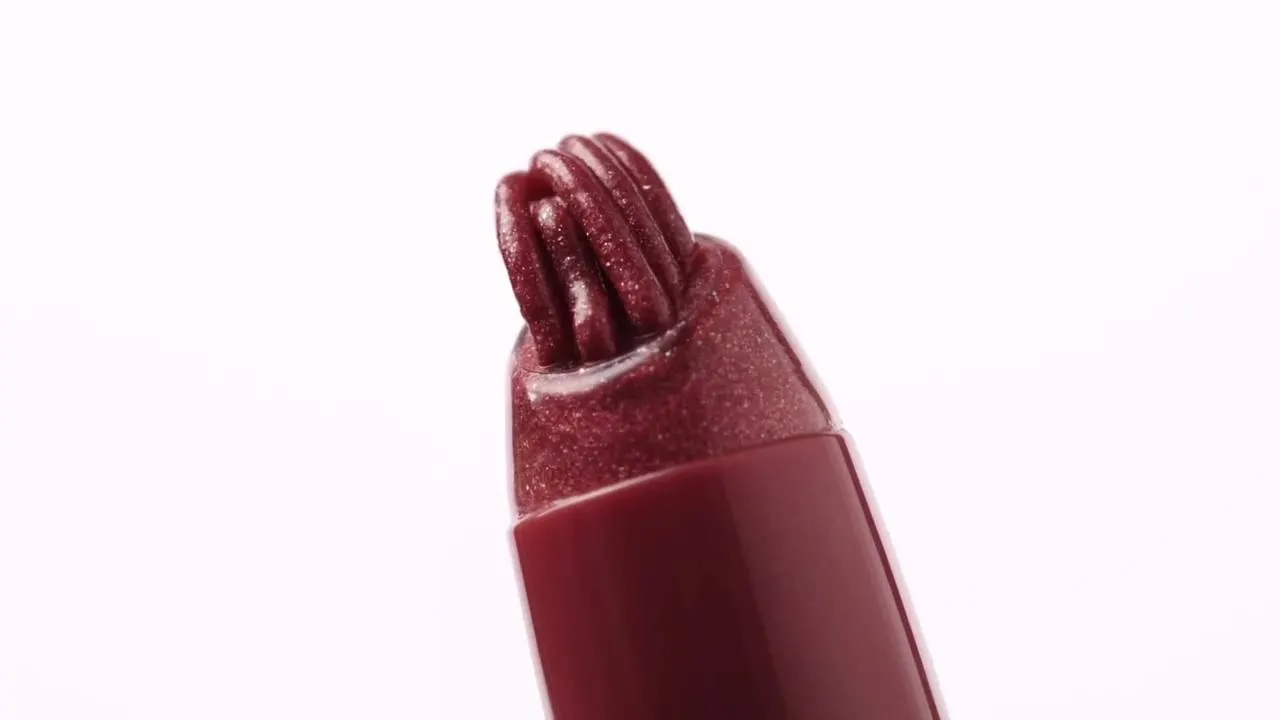
A cream is a solid in the pack, a semi solid on the finger, a liquid film on the skin and a matte finish thirty seconds later. A serum has its own speed down a dropper and its own way of holding a bead on glass. AI will give you a plausible liquid. It won't give you yours, and for a skincare brand the texture is the claim.
That's why swirls, smears and swatches still get made with real product on a real surface, on macro glass, under light that was tested before the shoot day. There's a rules angle here too, which we'll come to: a product performing on screen in a way the real one doesn't is a misleading claim, however beautiful the render.
Your exact pack, label and shade
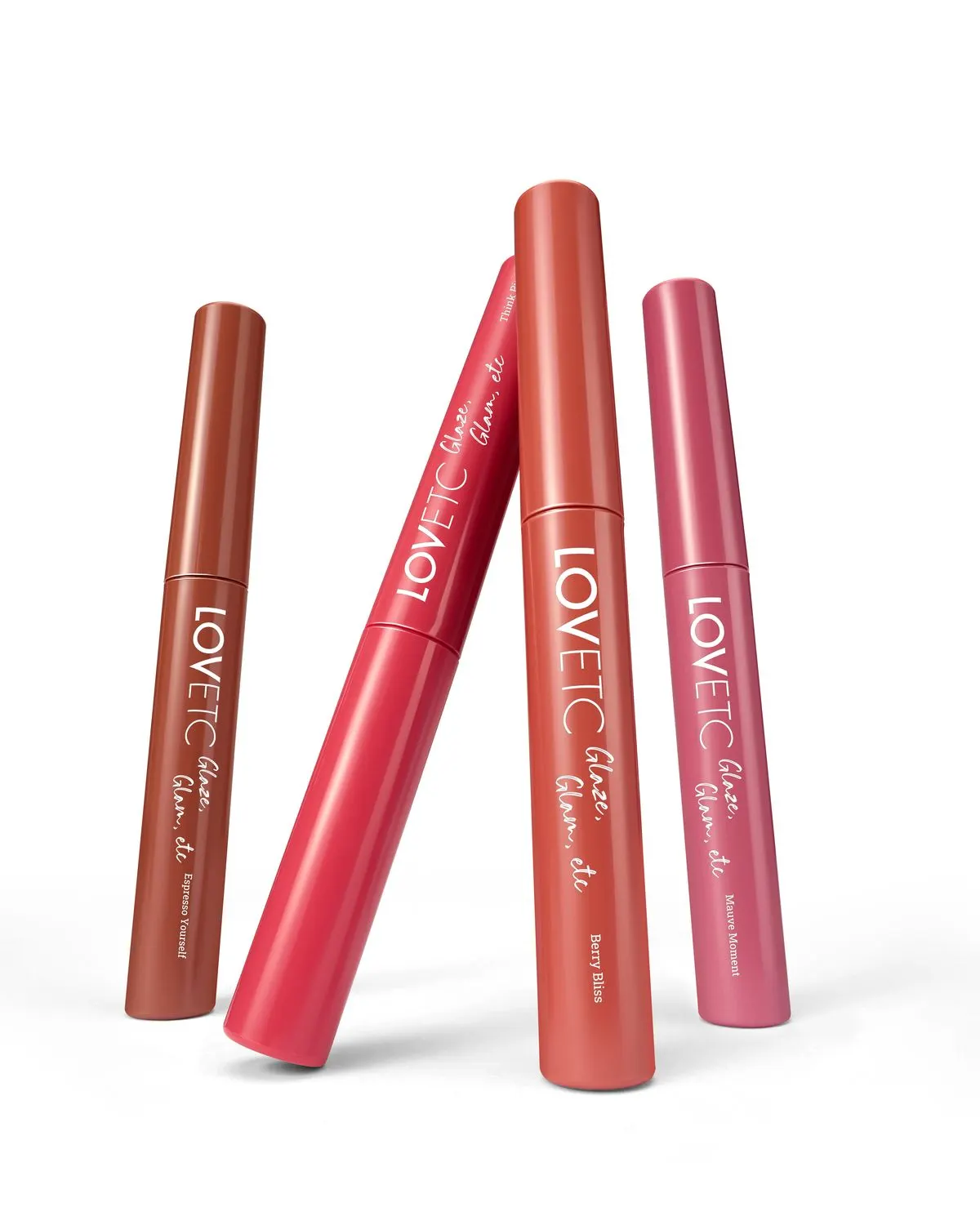
A generated bottle is a bottle. Yours has a specific cap, a specific mauve, a shade name in a specific script and a legal line that has to be readable. Across a few seconds of generated video, letters soften and rearrange, caps change proportion and the shade drifts a few points warmer. A shade that drifts in the ad becomes a disappointed customer when the parcel arrives. It's the first thing to check in any AI product video.
The usual fix is to photograph or 3D model the real pack and composite it in. Which works, and is also the exact moment the job stops being "just AI".
Hands, and the moment of application
Generated hands have improved a lot. Hands touching things are another matter: a finger pressing a pump, cream dragging across a cheek, a bullet meeting a lip. Contact is physics, and physics is the part the model is guessing. On a real set, application is also a continuity job: which finger, how much product, up or down the cheek, eyes open or closed. A generator doesn't keep that list. Somebody has to.
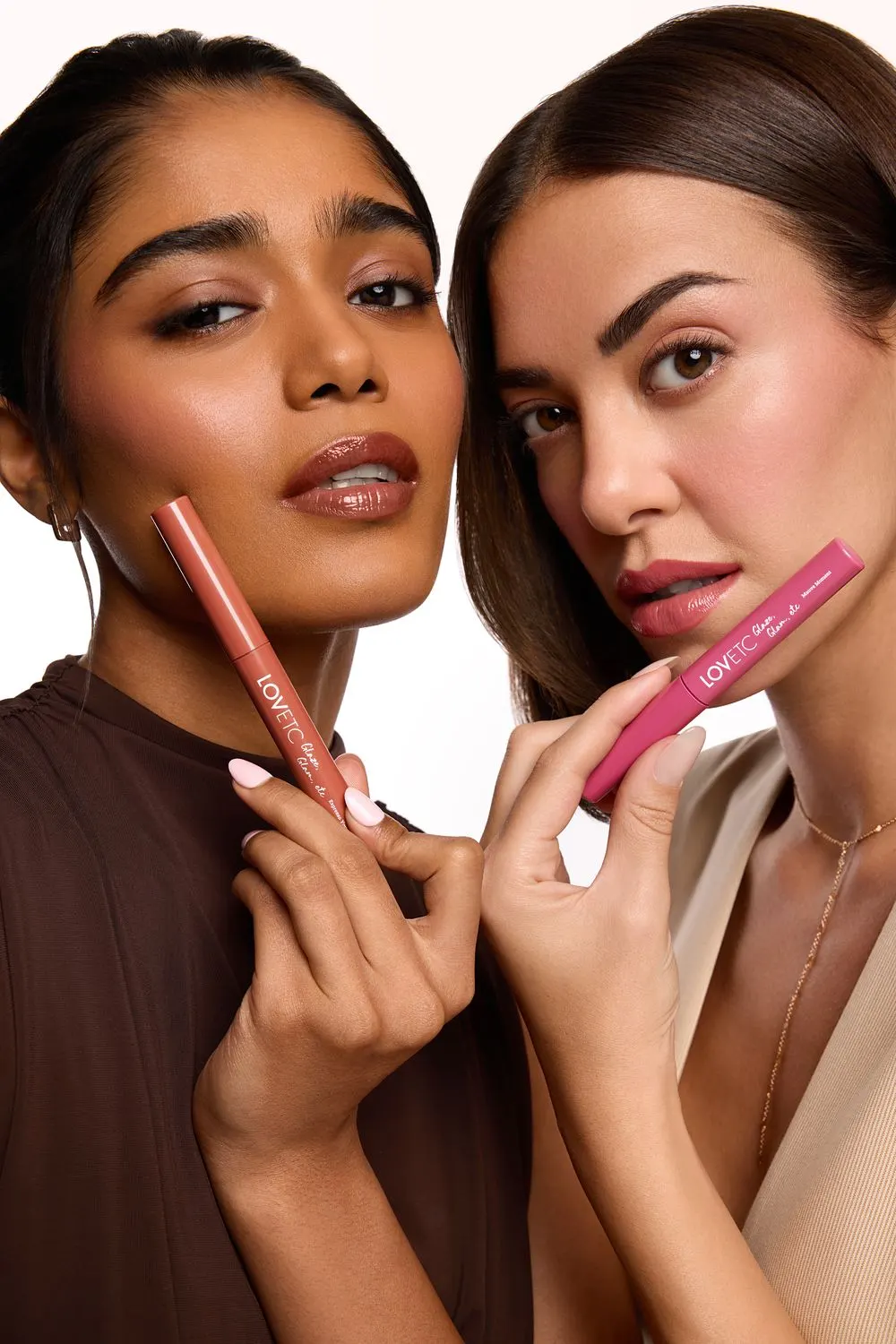
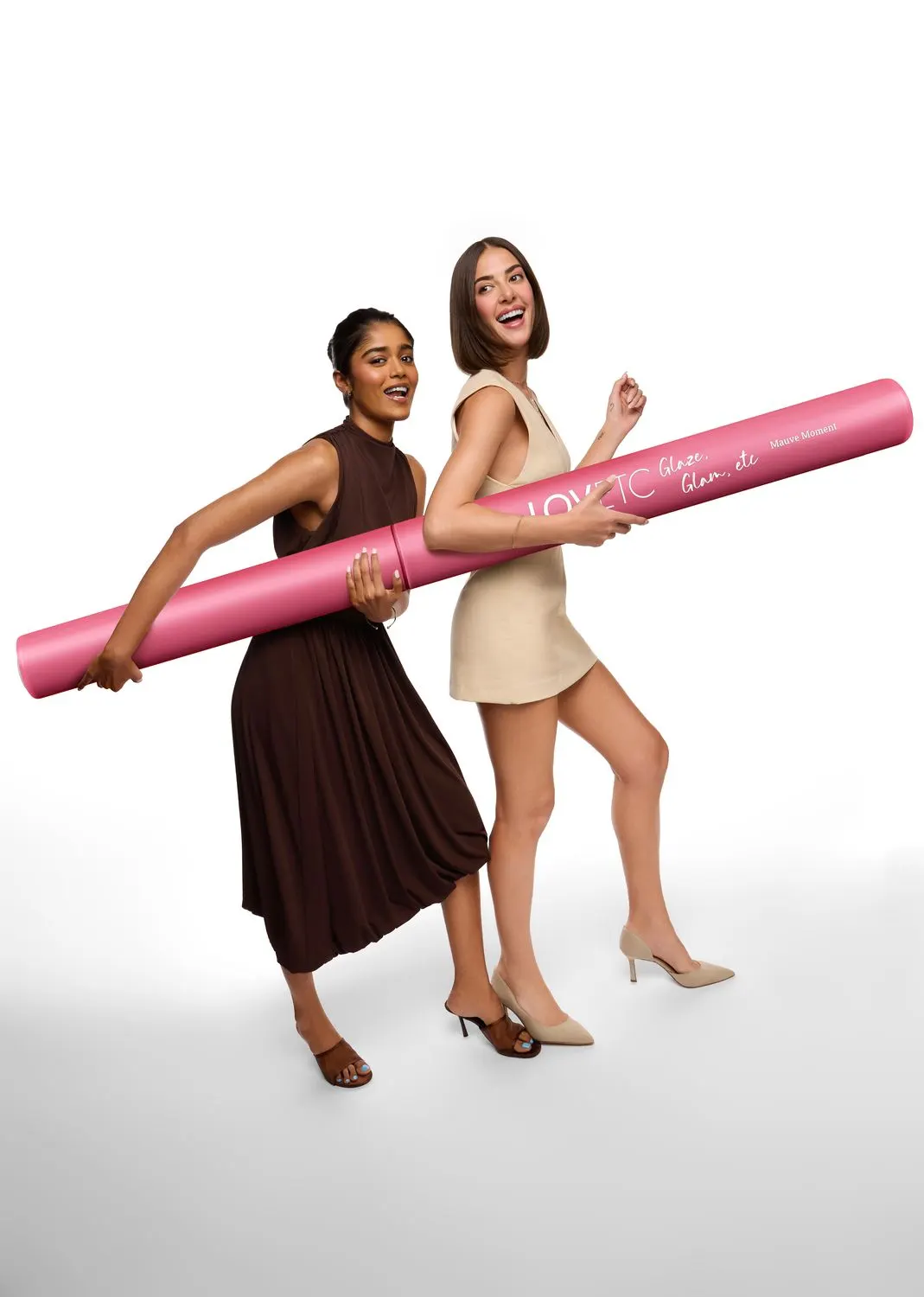
The oversized lip conditioner from our LOVETC campaign is exactly the kind of image people now generate. It was built for real, so the models could actually carry it and pose with it, and every hand on it looks like a hand holding something with weight.
Thirty seconds of the same face
A gorgeous five second clip is easy to demo. A thirty second film with the same face, the same product and the same light across eight cuts is where it gets hard: features drift, a mole moves, the key light swaps sides between shots. Every fix is a regeneration, and every regeneration can change something else. It's continuity, with a collaborator who forgets everything between takes.
Legal and brand certainty
The questions a brand's legal team asks don't go away because the footage was generated. Whose face is that, and did they agree to it? Does it happen to look like a real actor? Does the visual imply a result the product can't deliver? Does the ad code expect a label? What do the tool's terms say about commercial use, ownership of the output and where the training data came from? None of these are reasons to avoid AI. All of them need an answer in writing before the film goes live, not after a complaint.
Use AI for this, shoot this for real
If you want the short version to forward to your team, it's this.
| Use AI for | Shoot it for real |
|---|---|
| Concepts, mood and treatment frames | The hero product shot |
| AI storyboards and animatics | Texture: swatches, smears, drops, pours |
| Backgrounds, skies and set extensions | Skin, especially in close up |
| Versions, formats and localisation of approved shots | Hands and the moment of application |
| Ingredient fantasies and clearly stylised worlds | Anything that shows how the product performs |
| Rough social hooks to test | Your exact pack, label and shade |
Notice the pattern. The right column is everything your customer is checking. The left column is everything they aren't.
Hybrid AI and live action: the honest answer for most brands
For most beauty and product brands, the best current answer is neither "all AI" nor "no AI". It's hybrid. Shoot the truth, generate around it. The product, the texture and the skin get filmed for real, on real lenses, with an MUA (make-up artist) on the floor all day. The world around them (the location, the sky, the festive version, the ten formats) can come from AI.
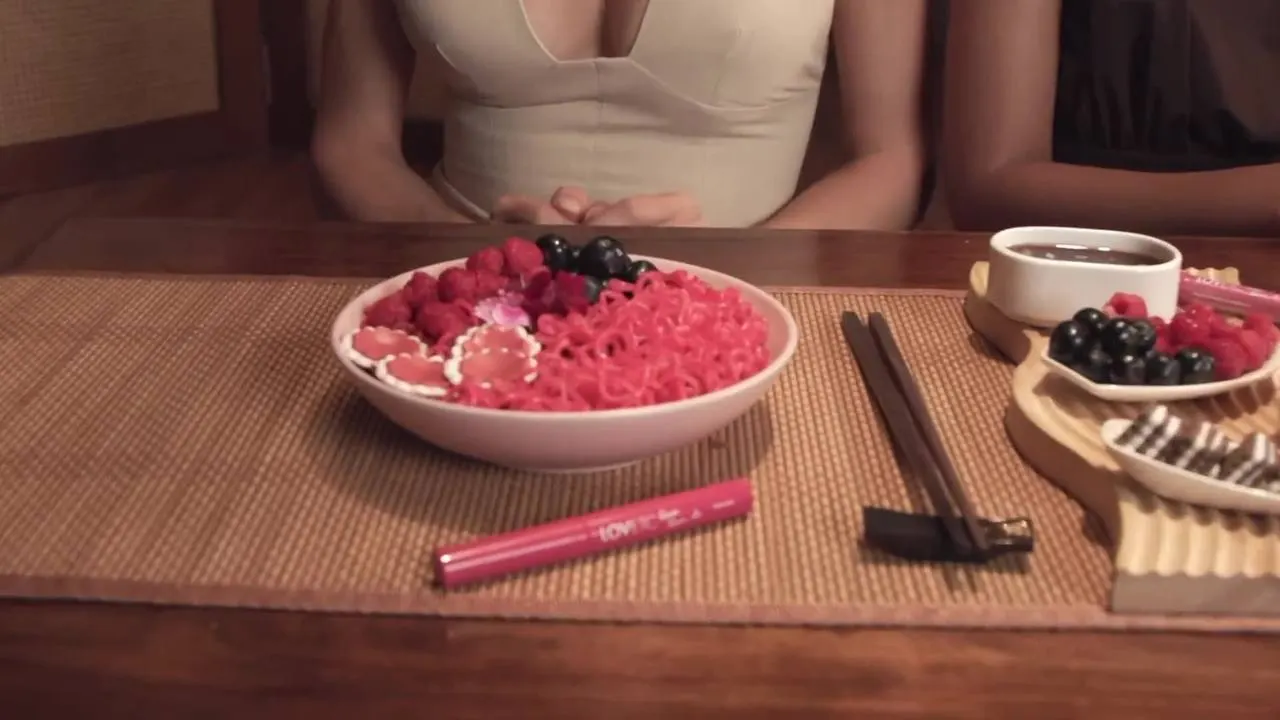
Done that way, the savings are real and they come from the right places: fewer set builds, no travel for a backdrop, one approved shot turned into many versions. The shoot day can get smaller, because it only has to capture the parts that must be true. The LOVETC hero film plated a lip conditioner on a restaurant table built inside our studio. Today, the restaurant is the part you could hand to a generator. The lip conditioner is the part you couldn't.
Our house rule is "make it, don't fake it", and it applies to an AI pipeline exactly as it does to a full crew. Real craft on every frame, whatever made the frame.
AI is brilliant at the world around your product. Your product is the part it keeps getting slightly wrong.
What actually drives AI video production cost
This is the section most pitches skip. The software is cheap. The film isn't, because the software was never the expensive part. Pricing an AI film by the subscription is like pricing a shoot by the camera rental.
Here is where the money goes on an AI or hybrid film a brand would actually put its name on.
- Concept and direction. Somebody still writes it, designs the look and decides what's good. Like the camera body on a set, the generator is the least interesting variable. Taste is the expensive bit.
- Generation and selection. Most generated shots get thrown away. You pay for the iterations and for the hours of the person picking one usable take out of dozens. Real shoots have a shooting ratio. AI has one too, and it's rarely flattering.
- Compositing and clean-up. Fixing a melted letter, a flickering earring, a sixth finger, then matching the grade (the colour finish) between generated and filmed shots. This is post production, and on many AI films it's the biggest line.
- The real shoot it still needs. Pack shots, texture plates, reference photos of the product so the model knows what it's drawing, often a proper hybrid shoot day. "No shoot" usually turns out to mean "a smaller shoot".
- Legal review. Likeness and consent, claim checks, disclosure labels, the tool's commercial terms.
- Revisions. On a shoot, a revision is an edit. In AI, a revision is often a regeneration, which can quietly change the shot you'd already approved.
"Can we just regenerate that one shot?" is the AI version of "just one more shot". It is also never five minutes.
For comparison, our live action film tiers are public: Rs 1 Lakh for a two person crew and a half day, Rs 5 Lakh for a six to eight person crew and a full day, Rs 15 Lakh for a campaign with full department heads. We've written up what each of those budgets actually buys. There is no honest equivalent rate card for AI films yet, ours included. The spread is too wide: an AI mood reel and an AI hero commercial are different jobs that happen to share a word. So we quote AI and hybrid work the way we quote everything else, from a written brief.
The pattern to expect on most beauty briefs: AI saves real money on the world (locations, builds, travel, versions) and very little on the truth (product, texture, skin), because you'll still be shooting those. If a quote claims to save heavily on both, ask what's being generated that you would otherwise have shot.
Do you have to tell people it's AI?
Increasingly, yes, depending on what the AI is doing. The Advertising Standards Council of India has published draft guidelines for labelling synthetically generated content in advertising, dated May 2026. They're built on risk rather than on the technology. Roughly:
- Not allowed, label or no label: fabricated endorsements or testimonials, visuals that exaggerate product results, deepfakes or a person's likeness used without consent, and AI-generated authority figures such as a fake doctor.
- Label required: virtual influencers and ambassadors, a real person's likeness or voice replicated for personalised messaging (even with consent), AI visuals of product performance unless they replicate how the product actually performs, and realistic events or settings created entirely with AI.
- No label needed: routine editing, colour correction, standard blemish removal, purely decorative backgrounds and obviously fantastical elements.
The suggested wording is plain: "Audio/Video created using AI" or "Audio/Video enhanced using AI". The draft says it aligns with the government's rules on synthetically generated information, amended in February 2026. Check whether the final version has landed before your film does.
Hybrid films sit in an interesting spot here. A purely decorative generated backdrop needs no label under the draft, while a realistic setting made entirely with AI does. Decide which one your film is at the brief, not in the edit.
For skincare, one line matters more than the rest. A render of a serum sinking into flawless skin with a glow no real bottle produced isn't a mood. It's a performance claim, and a label doesn't fix it. Shooting the real product does.
The platforms are moving the same way. Meta says it labels ads made or significantly edited with its own generative tools, says it will begin to detect ads made with third party AI tools, and puts the label right next to "Sponsored" when an ad contains an AI-generated photorealistic human. We're a production studio, not your lawyer, so run the final cut past whoever signs off on your claims.
Questions to ask any AI video production company
If you're shortlisting an AI video production company in India (or a studio like ours that also does AI, hello), these questions sort the real offers from the demo reels.
- Which shots are generated and which are filmed? Ask for the split shot by shot, not as a percentage.
- Can I see my actual SKU at second one and second thirty? A short test with your real pack, label and shade tells you more than any showreel.
- Whose face is it? Fully synthetic, or a real person who has agreed in writing, for which uses and for how long.
- What do the tool's terms say? Commercial use, ownership of the output, and anything on indemnity.
- Where does the label go, if one is needed? Decide it before the edit, not after the complaint.
- What counts as a revision? If regenerating one shot changes the rest of it, how many rounds are included?
- What happens if the test fails? The honest answer includes a plan B, and it usually involves a camera.
Quick answers
Is an AI ad cheaper than a real shoot?
Sometimes. AI is cheaper for environments, versions and volume, and rarely cheaper for a hero beauty film, because the product, the texture and the skin still need to be shot. Most of the saving comes from what you no longer have to build or travel to.
Can AI make my whole product film?
For a stylised or fantastical film, it can do most of it. For a film that shows your real pack, a real texture or skin in close up, not reliably yet, because labels, shades and product behaviour drift. The usual answer is a hybrid film built around a smaller real shoot.
Is it legal to use AI models in Indian ads, and do we need to disclose it?
Generally yes, with conditions. Under ASCI's May 2026 draft guidelines, a virtual model or influencer needs a clear AI label, while using a real person's likeness without consent, inventing an expert or exaggerating results is out even with a label. This isn't legal advice, so check the final guidelines and your platform's rules.
How long does AI video production take?
Generating a clip is quick. Getting to an approved film isn't, because the timeline is set by concept approval, revision rounds and clean-up. If the film includes a real shoot, that part runs on normal film time, and our published timeline for a commercial film is four to eight weeks from brief to delivery.
Will AI video look fake?
Only where it's asked to look real. Stylised worlds, skies and environments can look superb. Close ups of skin, product texture, hands and your exact pack are where viewers spot it first, and beauty audiences are very good at spotting it.
Last note
If someone offers you a whole skincare film in AI for a fraction of a shoot, don't argue. Ask for one test: your real SKU, a close up of skin, and a frame from second thirty. If it holds up, brilliant, you've found a useful tool. If it doesn't, you have your answer, and it cost you one test instead of one launch.
If you'd like help deciding which parts of your brief to generate and which to shoot, here is how we approach AI video production and hybrid films. Or skip the reading and send us the brief.